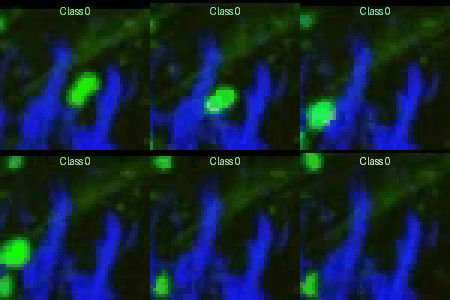

The Cell Behavior Video Classification Challenge (CBVCC) is designed to develop or adapt computer vision methods for classifying videos capturing cell behavior through Intravital Microscopy (IVM). IVM is a powerful imaging technique that allows for non-invasive visualization of biological processes in living animals. Platforms such as two-photon microscopes exploit multiple low-energy photons to deliver high-resolution, three-dimensional videos depicting tissues and cells deep within the body. IVM has been used to visualize a wide range of biological processes, including immune responses, cancer development, and neurovascular function.
The primary goal of the CBVCC challenge is to create models that can accurately classify videos based on the movement patterns of cells. Specifically, the models should be capable of:
The CBVCC challenge aims to provide a platform for researchers to develop innovative methods for classifying IVM videos, potentially leading to new insights into biological processes.
The CBVCC challenge is open to researchers worldwide. Participants are tasked with developing computational models to classify IVM videos. The models will be evaluated based on their accuracy in classifying videos.
The challenge is divided into two phases:
The final results will be determined based on the performance of the Phase 2 submissions.
Description: The CBVCC dataset comprises 2D video patches extracted from IVM videos capturing the behavior of regulatory T cells in the abdominal flank skin of mice undergoing a contact sensitivity response to the sensitizing hapten, oxazolone. Videos are acquired either 24 or 48 hours after the initial skin challenge, with each sequence lasting 30 minutes and images captured at one-minute intervals, resulting in 31 acquisitions per video.
Dataset license: CC-BY
How to cite: Cabini, Raffaella Fiamma, et al. "Cell Behavior Video Classification Challenge, a benchmark for computer vision methods in time-lapse microscopy." arXiv preprint arXiv:2601.10250 (2026).
The dataset includes:
The dataset consists of 300 2D video patches (180 class 0 and 120 class 1) extracted from 48 different videos. Each patch is a 2D projection along the z-axis of a 3D video sequence, adjusted to a common contrast range to enhance visibility. All videos have been preprocessed to ensure a uniform pixel size of 0.8 µm and are saved as RGB .avi files.
Dataset splits:
Each subset includes video patches extracted from different and independent IVM videos. In class 1, the change of direction occurs at the midpoint and center of the video patches.
Additional files (not provided during the challenge):
Models will be evaluated using the following metrics:
The final score is calculated as:
Score = 0.4 × AUC + 0.2 × (Precision + Recall + Balanced Accuracy)
Missing entries are automatically attributed with a wrong class.
The challenge is now closed.
To submit the results of your method, prepare a CSV file indicating the video id and the cass-1 probability [from 0 to 1].
(e.g.
02_12.avi,0.48
02_4.avi,0.65
02_3.avi,0.84
...
)
An example can be found here: https://www.dp-lab.info/cbvcc/sample_file.csv
Link to submit your results on the validation set (phase 1): https://www.dp-lab.info/cbvcc/data/submitpost1.php
Link to submit your results on the test set (phase 2): https://www.dp-lab.info/cbvcc/data/submitpost2.php
| # | Team name | Date of submission | Score |
|---|---|---|---|
| 1 | Computational Immunology (Radboud University) | 2024-12-20 16:55:47 | 0.96982 |
| 2 | UWT-SET (University of Washington) | 2024-12-21 07:40:43 | 0.90442 |
| 3 | GIMR (Garvan Institute of Medical Research) | 2024-12-20 01:07:40 | 0.88772 |
| 4 | QuantMorph (University of Toronto) | 2024-12-11 23:33:08 | 0.84204 |
| 5 | Computational Immunology (Radboud University) | 2024-12-20 16:54:10 | 0.83344 |
| 6 | GIMR (Garvan Institute of Medical Research) | 2024-12-03 12:13:24 | 0.83208 |
| 7 | dp-lab (USI) | 2024-12-06 16:26:39 | 0.8139 |
| 8 | Computational Immunology (Radboud University) | 2024-12-06 16:03:39 | 0.81206 |
| 9 | BioVision | 2024-12-01 07:18:40 | 0.8102 |
| 10 | LRI Imaging Core (Cleveland Clinic) | 2024-12-12 17:41:53 | 0.7942 |
| 11 | BioVision | 2024-12-01 06:17:15 | 0.78242 |
| 12 | Computational Immunology (Radboud University) | 2024-12-09 11:31:44 | 0.75092 |
| 13 | dp-lab (USI) | 2024-12-04 09:14:54 | 0.74998 |
| 14 | BioVision | 2024-12-18 09:39:18 | 0.71944 |
| 15 | BioVision | 2024-12-01 03:49:27 | 0.70664 |
| 16 | LRI Imaging Core (Cleveland Clinic) | 2024-12-12 17:36:22 | 0 |
| 17 | UWT-SET (University of Washington) | 2024-12-21 06:05:10 | 0 |
| # | Team name | Date of submission | Score |
|---|---|---|---|
| 1 | GIMR (Garvan Institute of Medical Research) | 2024-12-20 01:00:43 | 0.922 |
| 2 | LRI Imaging Core (Cleveland Clinic) | 2024-12-20 17:14:23 | 0.853 |
| 3 | QuantMorph (University of Toronto) | 2024-12-19 19:36:24 | 0.835 |
| 4 | dp-lab (USI) | 2024-12-18 13:36:07 | 0.815 |
| 5 | UWT-SET (University of Washington) | 2024-12-21 06:12:46 | 0.752 |
| 6 | Computational Immunology (Radboud University) | 2024-12-20 14:39:19 | 0.749 |
| 7 | BioVision | 2024-12-20 21:35:26 | 0.716 |